Today's Reminder
December 25, 2025 | Rajab 5, 1447
Living The Quran
Respect for Contract
Al-Anfal (The Spoils of War) - Chapter 8: Verse 172
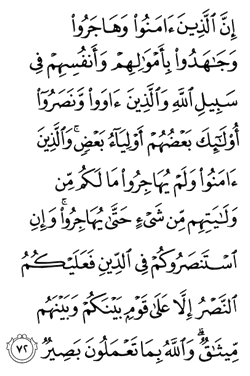 "Those who believed, who emigrated and struggled with their goods and themselves in the way of God, and those who gave them refuge and succor, they are allied with each other. And as for those who believed but who did not emigrate with you, you will not be bound to them as they did not emigrate. If they ask for your help in the name of religion, you must help them, except against people with whom you have concluded a treaty. God sees perfectly what you do."
if Muslims are treated unjustly or persecuted in a country with which another Muslim community has signed an agreement, it is impossible for the latter to intervene because respect for the contract overrides everything.
Although this verse refers to a situation in which two entities exist — for example, a Muslim state such as Medina and a non-Muslim neighbor — it is still possible to deduce at least three essential teachings:
1. Muslims are not responsible for those of the coreligionists who choose to live elsewhere and are bound to another state (by an explicit or tacit agreement).
2. It is the duty of Muslims to react when their brothers or sisters are exposed to persecution by reason of their religious beliefs.
3. However, the duty to help persecuted believers cannot be carried out if there is a treaty (of alliance or nonintervention), for such an intervention would mean a unilateral breach of the obligations of the agreement.
These three observations are of prime importance in discussions of the notion of umma and what is implied by being connected to it. One part of Muslim identity is guided by the principle of justice, but this may be restricted in certain circumstances when there are pacts which may be signed by Muslims—in their capacity as individuals or a community.
Compiled From:
"Belonging to the Islamic Umma" - Tariq Ramadan
From Issue: 904 [Read original issue]
Understanding The Prophet's Life
The Path of Reform
"Undoubtedly, within the body is a piece of flesh which, when it is in good condition (salaha), the whole body is also healthy and robust (salaha); but when it is degenerated (fasada), the whole body decays. Verily, that (part of the body) is the qalb (heart)." [Bukhari]
It is apparent from the words of the hadith, the Prophet (peace be upon him) was indeed referring to the piece of flesh in the shape of the heart inside our bodies. However, his usage goes far beyond the biological meaning of the word "heart". The term qalb has a far wider meaning in the Quranic and hadith terminology. According to this understanding, our entire personality can be termed as the qalb.
When people converse amongst themselves, they normally argue based on their own personal observations and within the ambit of their own literary expression. Although science declares that the Earth revolves around the Sun, you will still say that the Sun has risen and the Sun has set. Nobody will say that the Earth has risen or the Earth has set. Likewise, the accepted idiom in our language is that my heart says so, or my heart desires such and such. This is the accepted norm for expression. Therefore, to understand its meaning, it is not necessary to determine where the biological hub of intellect lies, or what is the centre of the mind.
The human being commits sins because his qalb is not well and he errs. According to this hadith, the path of islah (reformation) is the qalb. If the qalb is rectified, the other parts of the man's body will also function properly. It will bring forth the strength to obey the shariah leading to the islah (reformation) of one's entire life. And if the qalb is in discord, then the other parts of the body will also commit wrong acts. In such a case, shariah will remain only a written law, which will not be followed; and humanity will enter into a state of disarray and discord.
This hadith addresses another important point. Amongst Muslims, we are constantly faced with the ongoing debate between shariah (rule of law) and tariqah (the Sufi path), and between the zahir (apparent) and batin (hidden). Many people consider the domains of shariah and tariqah to be different. The Prophet has combined the two into one concept through the similitude of the human body (jasad), and he has demonstrated the unity in thought. The contrasts may be perceived between the qalb and the shariah, the inner private life or the outwardly explicit one. Just as one cannot imagine the qalb without the human body, how is it possible to conceive the association of a person's character, soul (ruh) and qalb with Allah without the establishment of salat (prayers), zakat (poor due) and fasting or without the strict observance of halal and haram? Likewise, one cannot imagine the existence of the body without the qalb. The two are portions of the same entity — belonging to the same whole and being parts of the same unity. The coupling between the two is inseparable and tied. It is not possible to distinguish between them.
Compiled From:
"A Righteous Heart: The Axis of One's Deeds" - Khurram Murad
From Issue: 1009 [Read original issue]
Cool Tips!
Finding Power
The abuse of power is costly in every imaginable way, from declining trust in the community to compromised performance at work to poor health. By contrast, when individuals use their power to advance the greater good, they and the people whom they empower will be happier, healthier, and more productive.
How can we stop ourselves from abusing power? The ethical principles that follow are one approach to enabling people to pursue this aspiration.
1. Be aware of your feelings of power
The feeling of power is like a vital force moving through your body, involving the acute sense of purpose that results when we stir others to effective action. This feeling will guide you to the thrill of making a difference in the world.
People who excel in their power—the physician who improves the health of dozens of people a day, the high school teacher who inches her students toward academic success, the writer whose piece of fiction stirs others’ imaginations—they all know this. They feel the rush of dopamine and vagus nerve activation in the purest moments of empowering others and lifting up the greater good.
If you remain aware of this feeling and its context, you will not be entrapped by myths that power is money, or fame, or social class, or a fancy title. Real power means enhancing the greater good, and your feelings of power will direct you to the exact way you are best equipped to do this.
2. Practice humility
Power is a gift—the chance to make a difference in the world. People who enact their power with humility enjoy more enduring power. Ironically, the more we approach our power, our capacity to influence others, with humility, the greater our power is. Don’t be impressed by your own work—stay critical of it. Accept and encourage the skepticism and the push-back of others who have enabled you to make a difference in the world. Remember that others have enabled you to make a difference in the world, and there is always more work to do.
3. Stay focused on others, and give
The most direct path to enduring power is through generosity. Give resources, money, time, respect, and power to others. In these acts of giving we empower others in our social networks, enhancing our own ability to make a difference in the world. Such acts of generosity are critical to strong societies, and empowered individuals are happier. The more we empower others, the greater good is increased.
4. Practice respect
By directing respect toward others, we dignify them. We elevate their standing. We empower them. That all members of a social collective deserve some basic form of dignity is an ancient basis of equality, and it is expressed in our day-to-day lives through respect. Practicing respect requires work. There is no reward people value more than being esteemed and respected. Ask questions. Listen with intent. Be curious about others. Acknowledge them. Compliment and praise with gusto. Express gratitude.
5. Change the psychological context of powerlessness
We can minimize the tendency of some people to feel below others, so toxic to health and well-being, by practicing the first four principles listed above.
We can do more, though. Pick one aspect of powerlessness in the world and change it for the better. The rise in inequality and the persistence of poverty give us many opportunities for such work. Attack the stigma that devalues women. Confront racism. Call into question elements of society—solitary confinement, underfunded schools, police brutality—that devalue people. Create opportunities within your community and workplace that empower those who have suffered disempowerment due to moral mistakes of the past.
Such steps may not feel like the game-changing social revolutions of earlier times, but they are quiet revolutions just the same. In every interaction, we have the opportunity to practice empathy, to give, to express gratitude, and to tell unifying stories. These practices make for social interactions among strangers, friends, work colleagues, families, and community members that are defined by commitment to the greater good, where the benefits people provide one another outweigh the harms they cause.
Compiled From:
"How to Find Your Power—and Avoid Abusing It" - Dacher Keltner
From Issue: 895 [Read original issue]